






































































































































































15 Pilates Exercises for Beginners at Home: A Gentle Start to Strength and Flexibility
Author: RVLNSV PRASAD
Updated On: October 2026
About Us
Author Bio
Editorial Policy
Contact Us
Introduction
Pilates exercises for beginners at home can be a practical way to start moving with more control, develop strength, and work on flexibility without buying expensive equipment. You do not need to master difficult positions or complete a long workout on your first day. A few well-chosen movements can help you learn the basics and build a routine that fits your daily life.
Many beginners assume that exercise must leave them exhausted to be effective. Pilates offers a different approach. It emphasizes controlled movement, breathing, balance, and awareness of body position. The exercises can be adapted to different abilities, although not every movement is suitable for every person.
This guide explains 15 beginner-friendly exercises, how to perform them, and how to combine them into a realistic weekly routine. You will also learn how to modify movements, avoid common mistakes, and assess progress without relying on exaggerated promises about rapid flexibility or strength gains.
The aim is simple: help you start with movements you can manage, understand why they are useful, and progress at a pace that feels sustainable.
Quick Answer: Which Pilates Exercises Are Best for Beginners?
Useful starting exercises include pelvic tilts, knee folds, leg slides, arm raises, shoulder bridges, spine stretches, cat-cow movements, side leg lifts, toe taps, bird dogs, wall roll-downs, seated twists, heel slides, standing balance, and controlled breathing.
You do not need to perform all 15 exercises in one session. Start with five or six that feel comfortable, practice them slowly, and rest between movements when needed.
The NHS beginner Pilates resource provides a guided workout and safety information. It notes that its general Pilates sessions are intended for people in good health with a reasonable level of fitness and advises seeking professional guidance when health concerns may affect exercise suitability.
Key Takeaways
- Pilates combines controlled movement, breathing, posture, and body awareness.
- Beginners can practice many mat-based exercises at home without special equipment.
- A shorter, controlled session is a reasonable starting point.
- Pilates may improve some measures of flexibility, balance, strength, and physical function, but results vary.
- Do not rely on unsupported claims that Pilates improves flexibility by a fixed percentage.
- Choose modifications that let you move comfortably rather than forcing difficult positions.
- Pilates can complement walking and other strength or aerobic activities, but it does not replace every form of exercise.
What Is Pilates, and How Does It Work?
Pilates is a form of exercise that emphasizes controlled movement, breathing, trunk stability, posture, and coordination. Many beginner mat exercises use body weight and a floor mat, although a mat is optional for some movements.
Rather than focusing only on the number of repetitions, Pilates encourages attention to how the body moves. For example, during a heel slide, you move one leg while trying to keep the rest of your body controlled. During a shoulder bridge, you lift your hips without forcing your lower back into an exaggerated arch.
These exercises can challenge several muscle groups at once. The abdominal muscles, back muscles, hips, and buttocks may all contribute, depending on the movement.
The Mayo Clinic’s overview of core-strength exercises explains why strengthening the muscles around the trunk can be useful for movement and stability. However, Pilates is not the only way to develop these qualities; other forms of strength training can also help.
Is Pilates suitable for beginners?
Many Pilates exercises have beginner variations, and the NHS provides a Pilates workout for beginners and people returning to the basics.
Still, beginner-friendly does not mean universally safe. Your current fitness, mobility, symptoms, and medical history matter. If you have a recent injury, persistent pain, are pregnant or have recently given birth, or have another health concern, ask a qualified healthcare professional about suitable modifications.
What Does the Latest Research Say About Pilates?
Research suggests that Pilates may support several aspects of physical fitness, but the strength of the evidence differs by outcome.
An umbrella review published in 2023 examined 27 systematic reviews with meta-analyses covering a range of health outcomes. The authors reported promising findings for outcomes such as balance, sleep quality, body composition, and some pain-related measures. However, most of the included reviews were rated low or critically low in methodological quality, and the certainty of evidence varied. Read the full umbrella review on PubMed.
A 2024 systematic review examined Pilates and body posture. It included 13 studies involving 783 participants and found evidence suggesting potential benefits for posture-related outcomes, while also noting limitations in study quality and design. Explore the 2024 systematic review on Pilates and posture.
Research published in 2025 also examined Pilates for musculoskeletal conditions affecting the arms and legs. Its review of 11 studies involving 444 participants reported improvements in some pain, disability, and quality-of-life outcomes compared with control groups. The authors emphasized that the certainty of evidence was very low and that superiority over other exercise approaches remained unclear. Read the 2025 systematic review on PubMed.
A further systematic review and meta-analysis published in 2026 examined Pilates programs in adult women. It reported improvements in flexibility and selected body-composition outcomes, but not every measure changed significantly. The researchers also highlighted differences between studies and limitations in the available evidence. See the 2026 review on PubMed.
What should beginners take from this research? Pilates is a reasonable exercise option for developing movement skills and working on selected aspects of fitness. However, these studies do not establish that every beginner will experience the same results or that a particular routine will improve flexibility by 30% or strength by 25%.
15 Pilates Exercises for Beginners at Home
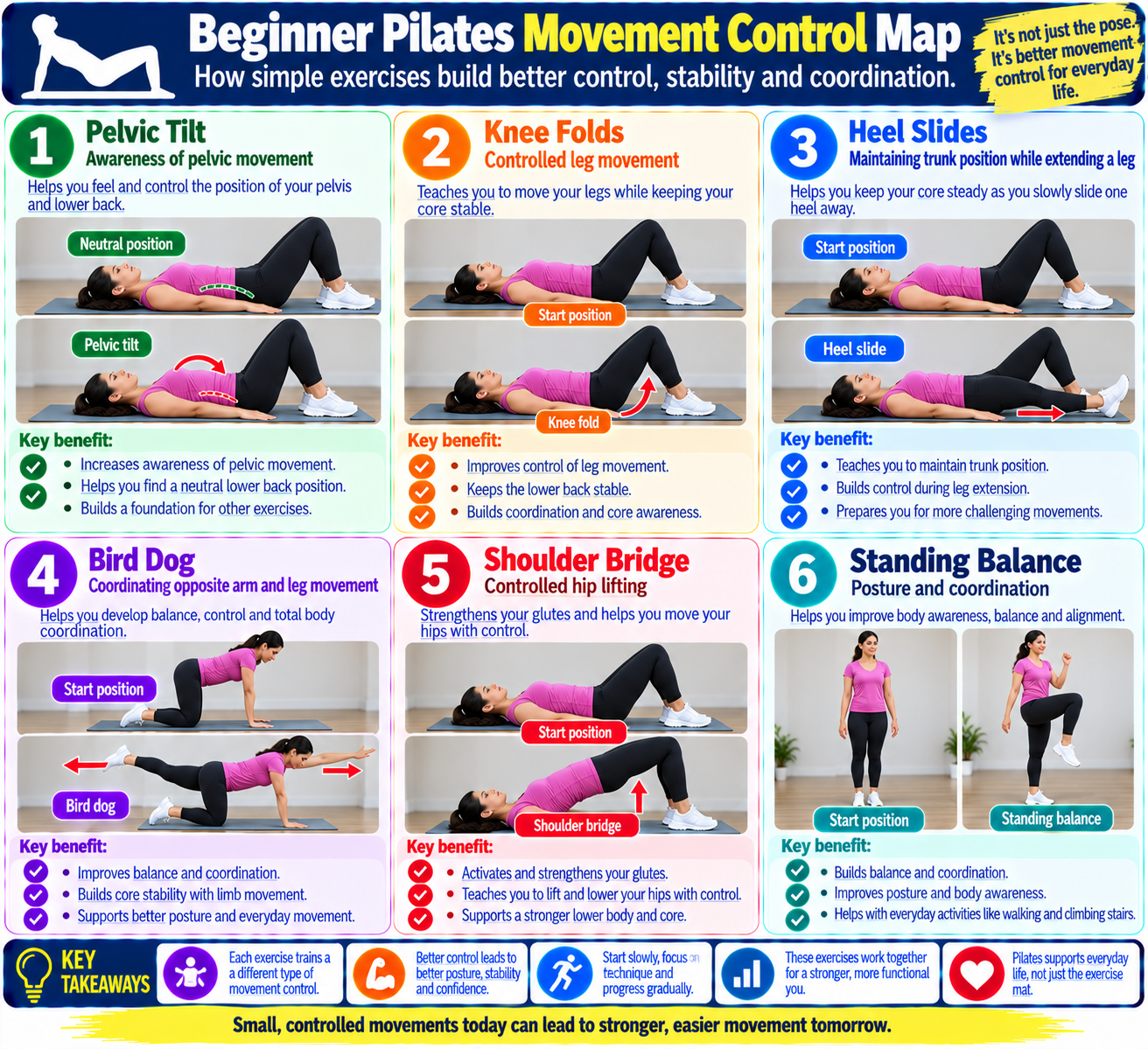
The following exercises are designed as general starting options. Move slowly, breathe normally, and use a comfortable range of motion. You can skip any movement that does not suit your abilities.
1. Pelvic Tilt
Pelvic tilts introduce gentle control of the pelvis and lower trunk. They are often used to help people become familiar with moving their pelvis while lying down.
How to do it
- Lie on your back with your knees bent and feet flat.
- Allow your back to rest in a comfortable position.
- Gently tighten your abdominal muscles and tilt your pelvis so your lower back moves closer to the floor.
- Hold briefly while breathing normally.
- Relax before repeating.
Beginner tip: Keep the movement small. Do not force your back against the floor or hold your breath.
Why it helps: Pelvic tilts provide a simple way to practice pelvic control and body awareness. They should not be presented as a guaranteed treatment for back pain.
2. Knee Folds
Knee folds challenge your ability to move one leg while keeping your trunk controlled. They can also prepare you for more demanding movements.
How to do it
- Lie on your back with both knees bent and feet flat.
- Gently engage your abdominal muscles.
- Lift one foot a short distance from the floor.
- Return it slowly.
- Repeat on the opposite side.
Beginner tip: Keep your pelvis steady and avoid lifting your knee higher than feels comfortable.
Why it helps: The movement encourages coordination between the legs and trunk. It is more useful to focus on control than on lifting the knee quickly.
3. Leg Slides
Leg slides are a simple way to practice moving the legs without losing control of your body position.
How to do it
- Lie on your back with your knees bent.
- Gently engage your abdominal muscles.
- Slide one heel forward until the leg is more extended.
- Bring the heel back slowly.
- Alternate sides.
Beginner tip: Shorten the movement if your lower back begins to arch excessively or you feel discomfort.
Why it helps: Leg slides challenge coordination and trunk control while keeping the movement relatively simple.
4. Arm Raises
Arm raises allow beginners to practice shoulder movement while maintaining a comfortable trunk position.
How to do it
- Lie on your back with your knees bent, or sit comfortably upright.
- Begin with your arms resting beside your body.
- Raise your arms slowly toward the ceiling or overhead, as far as comfortable.
- Lower them with control.
Beginner tip: Avoid forcing your shoulders toward your ears. If raising your arms overhead causes discomfort, reduce the range of motion.
Why it helps: The exercise encourages controlled shoulder movement and awareness of posture. It can be a useful warm-up or mobility exercise.
5. Shoulder Bridge
The shoulder bridge works the buttocks and hips while requiring control of the trunk. It is a common exercise in mat-based strength routines.
How to do it
- Lie on your back with your knees bent and feet flat.
- Position your feet comfortably apart.
- Gently tighten your abdominal muscles and buttocks.
- Lift your hips until your body forms a comfortable line from your shoulders toward your knees.
- Lower slowly.
Beginner tip: Lift only as high as you can without arching your lower back or holding your breath.
Why it helps: The bridge strengthens the gluteal muscles and challenges control around the hips and trunk. It is one useful part of a balanced routine, rather than a complete workout by itself.
6. Spine Stretch
A seated spine stretch encourages comfortable movement through the upper body. It should feel controlled rather than forced.
How to do it
- Sit with your legs extended or slightly bent, whichever is more comfortable.
- Sit tall without forcing your back into a rigid position.
- Reach your arms forward.
- Gently lean forward from the hips while keeping the movement comfortable.
- Return to the starting position.
Beginner tip: If sitting on the floor is uncomfortable, sit on a folded towel or use a chair to make the position easier.
Why it helps: The exercise encourages trunk movement and body awareness. It is not necessary to reach your toes to benefit from practicing a comfortable stretch.
7. Cat-Cow Movement
Cat-cow is a gentle movement performed on the hands and knees. It encourages comfortable spinal movement rather than holding the back in one position.
How to do it
- Begin on your hands and knees.
- Position your hands below your shoulders and your knees below your hips.
- Slowly round your back within a comfortable range.
- Return through a neutral position and gently extend your spine.
- Repeat while breathing naturally.
Beginner tip: Keep the movement smooth. Do not push into an extreme arch or round your back forcefully.
Why it helps: Cat-cow encourages spinal mobility and awareness of body position. If kneeling is uncomfortable, ask a physiotherapist about an appropriate alternative.
8. Side-Lying Leg Lift
Side-lying leg lifts primarily train the muscles around the hip. They also require you to maintain a stable position while the upper leg moves.
How to do it
- Lie on one side with your legs extended comfortably.
- Support your head with your arm.
- Keep your hips stacked rather than rolling backward.
- Lift the upper leg a short distance.
- Lower it slowly and repeat before switching sides.
Beginner tip: Keep the movement small and avoid swinging your leg to gain height.
Why it helps: The exercise strengthens the hip muscles, which contribute to movement and pelvic control. It complements more direct trunk exercises.
9. Toe Taps
Toe taps challenge trunk control as the legs move. Beginners can start with one leg at a time.
How to do it
- Lie on your back with your knees bent.
- If comfortable, lift your legs so your hips and knees are bent.
- Lower one foot toward the floor and gently tap it down.
- Return to the starting position.
- Alternate sides.
Beginner tip: If lifting both legs makes it difficult to control your back, keep one foot on the floor and practice the movement with the other leg.
Why it helps: Toe taps challenge coordination between the legs and trunk. The movement should remain controlled rather than becoming a race to complete repetitions.
10. Bird Dog
Bird dog combines balance, coordination, and trunk stability. It is performed on your hands and knees.
How to do it
- Start on your hands and knees.
- Keep your back in a comfortable, neutral position.
- Extend one leg behind you without twisting your trunk.
- Return to the starting position.
- Switch sides.
When this becomes manageable, extend the opposite arm and leg together.
Beginner tip: Start with one limb at a time if the full movement feels unstable.
Why it helps: The bird dog challenges the trunk to remain steady while the arms or legs move. It is a useful exercise for practicing coordination and controlled movement.
11. Wall Roll-Down
The wall roll-down is a gentle movement that encourages awareness of spinal position. It should not be forced, and a comfortable range is more important than reaching the floor.
How to do it
- Stand with your back near a wall and your feet slightly forward.
- Relax your shoulders.
- Gently lower your chin and begin bending forward a little at a time.
- Move only as far as comfortable.
- Slowly return to standing.
Beginner tip: Use a smaller movement if you feel dizzy, unsteady, or uncomfortable. You can also practice standing tall and gently bending forward without using the wall.
Why it helps: The exercise encourages controlled movement and body awareness. It is not a guaranteed method for correcting posture.
12. Seated Twist
A seated twist encourages gentle trunk rotation. It should not create a sharp pulling sensation in the back.
How to do it
- Sit upright on a chair or on the floor.
- Keep your shoulders relaxed.
- Rotate your upper body gently to one side.
- Return to the center and repeat on the other side.
- Keep your hips steady as much as comfortable.
Beginner tip: Use a small range of motion. Avoid pulling yourself farther into the twist with your arms.
Why it helps: Seated twists provide an opportunity to practice comfortable trunk rotation and movement awareness.
13. Heel Slides
Heel slides are similar to leg slides and can be used as a simple movement-control exercise. If you already perform leg slides comfortably, you do not need to include both in every session.
How to do it
- Lie on your back with your knees bent.
- Slowly slide one heel away from your body.
- Keep the movement smooth and comfortable.
- Bring the heel back.
- Repeat on the other side.
Beginner tip: Avoid allowing the movement to pull your back into an uncomfortable position.
Why it helps: Heel slides give beginners another way to practice controlled leg movement while lying down.
14. Standing Balance
Standing balance introduces a simple challenge without requiring floor exercises. Use a wall or stable support nearby if you are unsure of your balance.
How to do it
- Stand with your feet comfortably apart.
- Shift your weight gradually onto one foot.
- Lift the other foot a small distance from the floor.
- Hold briefly while breathing normally.
- Return to both feet and switch sides.
Beginner tip: Keep one hand near a stable support. Start with just a few seconds rather than trying to balance for a long time.
Why it helps: The exercise challenges balance and coordination. For older adults, balance training can be particularly useful when adapted to individual ability. The WHO physical activity guidance recommends varied activity that includes balance and strength work for older adults with poor mobility.
15. Controlled Breathing
Breathing practice can help you coordinate movement and avoid unnecessary breath-holding during exercise. It is not a replacement for strengthening or aerobic activity.
How to do it
- Sit or lie in a comfortable position.
- Relax your shoulders and jaw.
- Breathe in gently without forcing a deep breath.
- Breathe out slowly and comfortably.
- Continue for one or two minutes.
Beginner tip: Do not force your breathing or hold your breath for long periods. Stop if you feel light-headed.
Why it helps: Controlled breathing can help you pay attention to how you feel during exercise. In Pilates, breathing is a useful part of coordinating movement rather than a separate treatment for a medical condition.
A Simple Beginner Pilates Routine
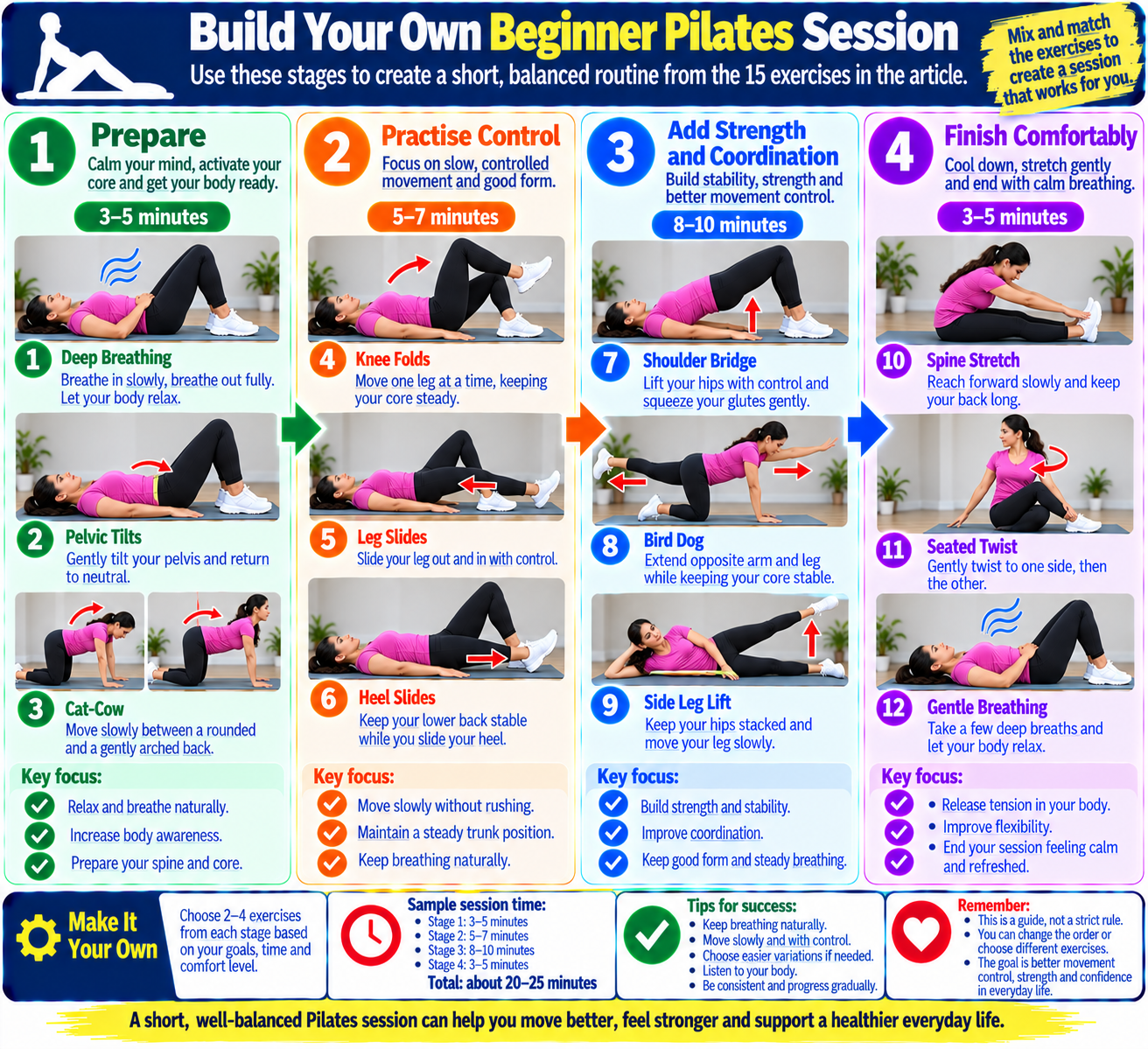
You do not need to complete all 15 exercises in one session. Start with a manageable selection, then add movements as you become familiar with the routine.
Sample 12–15-minute session
| Stage | Exercise | Suggested amount |
|---|---|---|
| Warm-up | Comfortable marching and shoulder movements | 2–3 minutes |
| 1 | Pelvic tilt | 6–10 repetitions |
| 2 | Knee folds | 5–8 per side |
| 3 | Heel slides | 5–8 per side |
| 4 | Shoulder bridge | 6–10 repetitions |
| 5 | Bird dog | 4–6 per side |
| 6 | Side-lying leg lift | 6–8 per side |
| Cooldown | Gentle breathing and comfortable movement | 1–2 minutes |
These amounts are practical starting suggestions, not a universal prescription. Reduce the repetitions, rest longer, or choose different exercises if needed.
How often should beginners practice Pilates?
Two or three sessions per week can be a reasonable starting point for many beginners. Leave time for recovery, and adjust your schedule according to your abilities and other activities.
The World Health Organization’s physical activity guidelines recommend regular aerobic activity and muscle-strengthening activity on at least two days per week for adults. Pilates may contribute to a broader fitness routine, but it does not automatically meet every aerobic or strength-training goal.
A simple weekly schedule could include Pilates on Monday and Thursday, comfortable walking on other days, and rest or gentle mobility when needed. You can change this schedule to fit your life.
How to Progress Without Rushing
Progress does not mean making every movement more difficult each week. It means choosing a level that challenges you while allowing you to maintain control.
| Stage | Main goal | Example |
|---|---|---|
| Week 1 | Learn the movements. | Practise four or five exercises. |
| Week 2 | Improve control. | Repeat the same exercises with steady breathing. |
| Week 3 | Build consistency. | Add a few repetitions if comfortable. |
| Week 4 | Review your response | Keep the same level or make one small adjustment. |
Some beginners will need more than four weeks to feel comfortable with the routine. That is normal. You can repeat a stage until the movements feel manageable.
Before progressing, ask yourself three questions: Can I breathe normally? Can I control the movement? Do I feel comfortable afterward? If the answer to any of these is no, reduce the difficulty or seek appropriate guidance.
Common Pilates Mistakes Beginners Should Avoid
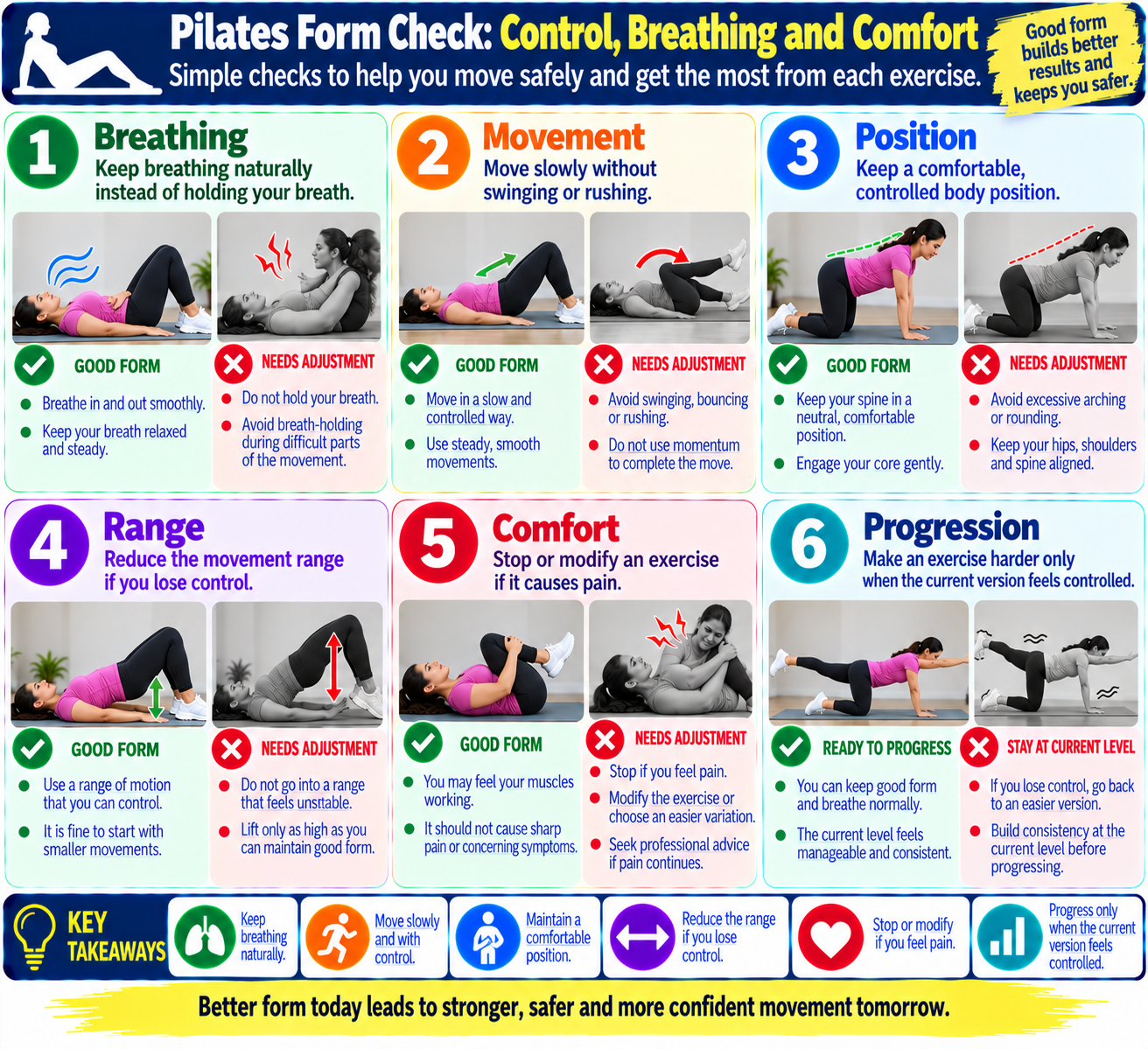
Trying to copy advanced movements too soon
Social media often shows challenging Pilates exercises without explaining the preparation needed to perform them. Start with the basic variation and develop control before attempting a more difficult movement.
Holding your breath
Breath-holding can make exercises feel harder and interfere with smooth movement. Breathe naturally, and pause if you need to regain control.
Forcing flexibility
A stretch does not have to feel intense to be useful. Avoid pushing into pain or trying to match another person’s range of motion.
Assuming low impact means risk-free
Pilates can be gentle, but exercises may still aggravate an injury or condition when they are unsuitable. The NHS advises stopping if you experience pain or become unwell during its general Pilates sessions. Read its beginner Pilates safety guidance.
Doing the same movements every day without recovery
Consistency is helpful, but more sessions are not always better. Allow time to recover and consider your overall activity level.
Expecting a fixed percentage of improvement
Claims such as “30% more flexibility” are meaningful only when tied to a specific study, population, measurement method, and training program. Results from one study cannot automatically be applied to every beginner.
Practical Habits That Support Your Pilates Routine
Link exercise to an existing daily habit
Choose a time that fits your schedule, such as after your morning routine or before a regular walk. A simple schedule can make it easier to practice consistently.
Make your workout space comfortable
Clear loose objects from the floor, wear comfortable clothing, and use a mat or folded towel if needed. Keep a stable support nearby for standing balance exercises.
Track movement quality rather than perfection.
After each session, record which exercises you completed and whether you could breathe and move comfortably. You can also note whether the same movements feel easier over time.
Include other forms of physical activity.
Pilates can complement walking, cycling, swimming, and appropriate strength training. A varied routine helps you work on different aspects of fitness instead of expecting one exercise method to do everything.
Eat regularly and recover adequately.
A balanced diet, enough sleep, and suitable recovery support general health and physical activity. Warm water or herbal tea may be enjoyable, but neither has been shown to make Pilates results happen faster by itself.
Frequently Asked Questions
1. What are Pilates exercises for beginners?
They are introductory movements that emphasize controlled movement, breathing, balance, and body awareness. Examples include pelvic tilts, knee folds, heel slides, shoulder bridges, and bird dogs.
2. Can I do Pilates at home without equipment?
Yes. Many mat-based and standing Pilates exercises use only body weight. A mat can make floor movements more comfortable, but specialized equipment is not necessary for the exercises in this guide.
3. How often should beginners practice Pilates?
Two or three sessions per week may be a manageable starting point for many people. Your schedule should reflect your current fitness, recovery, and other activities.
4. How long does it take to notice results?
There is no universal timeline. Some people may notice improvements in movement control or exercise tolerance before they notice changes in flexibility or strength. Results depend on the program, consistency, starting ability, and other factors.
5. Is Pilates safe for people with back pain?
Some Pilates-based programs may help certain people with back pain, but not every movement suits every condition. If you have persistent or worsening pain, consult a qualified healthcare professional or physiotherapist before following a general routine.
6. Can Pilates help with weight loss?
Pilates uses energy and can contribute to an active lifestyle, but it does not guarantee weight loss. Weight management depends on several factors, including food intake, total activity, sleep, and individual health.
7. Is Pilates enough exercise for general health?
Pilates can be one part of a balanced fitness routine. Adults should also aim for recommended amounts of aerobic activity and muscle-strengthening exercise. See the WHO physical activity recommendations for general guidance.
Conclusion
Pilates exercises for beginners at home offer a practical way to start developing strength, flexibility, balance, and movement control. You can begin with simple exercises such as pelvic tilts, knee folds, leg slides, shoulder bridges, and bird dogs, then add other movements as you become more comfortable.
Keep the first sessions short and focus on technique rather than speed. Choose modifications that suit your current abilities, allow time for recovery, and avoid forcing a movement that causes pain.
Research suggests that Pilates may improve selected aspects of physical fitness and function, although the strength of the evidence varies. It should not be presented as a guaranteed treatment for pain or as a replacement for other forms of physical activity.
The most useful routine is one you can practice consistently and adjust as your needs change. Start with a few movements, pay attention to how you feel, and build from there.
Author Note
Author: RVLNSV PRASAD
This article provides general educational information about beginner Pilates and home exercise. Research references are included so readers can explore the evidence behind relevant claims. Include personal experiences or coaching examples only when they accurately reflect genuine experience.
Medical Disclaimer
This article is for general informational purposes and is not a substitute for medical advice, diagnosis, or treatment. Exercise suitability varies according to health status, symptoms, medications, and physical abilities. Consult a qualified healthcare professional if you have persistent pain, a recent injury, or a recent operation; are pregnant or have recently given birth; or are unsure whether these exercises are suitable for you.
Fitness Disclaimer
Exercise carries some risk, even when movements are low impact. Use a clear space, select movements appropriate for your abilities, and stop if you experience pain or become unwell. The routine in this article is a general starting example, not an individualized exercise prescription.
Evidence-Based Sources
- NHS — Pilates for Beginners
- Mayo Clinic — Core Strength Exercises
- Pilates and Multiple Health Outcomes: An Umbrella Review, 2023
- Effects of Pilates on Body Posture: A Systematic Review, 2024
- Pilates for Musculoskeletal Conditions in the Extremities: A Systematic Review, 2025
- Effects of Pilates Programs on Physical Fitness in Adult Women: Systematic Review and Meta-Analysis, 2026
- World Health Organization—Guidelines on Physical Activity and Sedentary Behavior
Related Articles
- Chest Workouts Without Equipment: Best 12 Moves to Build Muscle at Home
- Best 8 Weight Loss Exercises










[…] 15 Pilates Exercises for Beginners: A Gentle Start to Core Strength and Flexibility […]